When One Becomes Two: The Fission Puzzle

Imagine waking up tomorrow morning and discovering that there are two of you. Not metaphorically—literally. Two people, each with your exact memories, your personality, your deepest fears and fondest hopes. Both absolutely convinced they are the "real" you. This isn't science fiction; it's one of philosophy's most mind-bending thought experiments, and it strikes at the heart of what makes you... you.
The fission scenario, popularized by philosopher Derek Parfit, begins with a medical reality that already challenges our assumptions about consciousness. Split-brain surgery—cutting the corpus callosum that connects the brain's hemispheres—has been performed for decades to treat severe epilepsy. But what if we took this division much further? What if we could transplant each hemisphere into a separate body, creating two complete persons from one? The implications are staggering, and they force us to confront fundamental questions about personal identity that most of us never think to ask.
The Medical Foundation: Split-Brain Surgery
Before diving into the philosophical depths, let's ground ourselves in medical reality. Split-brain surgery involves severing the corpus callosum—a thick bundle of nerve fibers that normally allows the brain's two hemispheres to communicate. This procedure has been performed on patients with severe, medication-resistant epilepsy since the 1960s, often with remarkable success in reducing seizures.
What's fascinating is what researchers discovered about these patients. Early studies suggested that cutting this neural bridge created something like two separate consciousnesses within one skull. Each hemisphere could respond independently to stimuli, sometimes even appearing to have different preferences or reactions. The left hand might unbutton a shirt that the right hand had just buttoned, as if two different agents were inhabiting the same body.
However, recent research has complicated this picture. Many split-brain patients report feeling unified and whole, leading some neuroscientists to argue that consciousness remains integrated even after the corpus callosum is severed. The brain, it seems, is remarkably adaptable, finding alternative pathways to maintain unity. But this medical reality provides the launching pad for a much more radical thought experiment.
The Fission Scenario: One Becomes Two
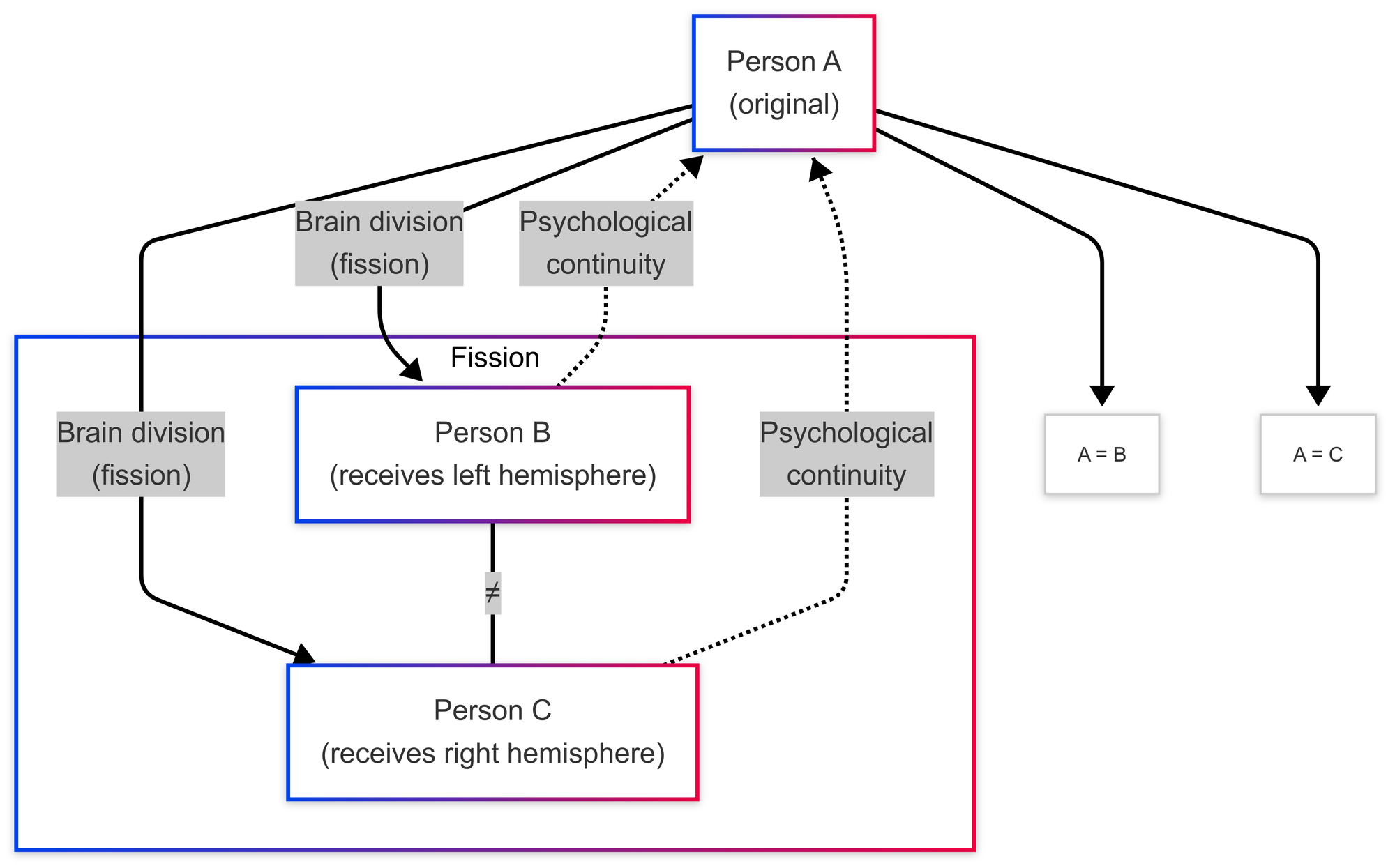
Now imagine we could go much further than split-brain surgery. Picture a person—let's call her Anna—who needs a radical medical intervention. Her brain is carefully divided into two hemispheres, each transplanted into an identical body. The original body is destroyed, but both recipients inherit Anna's complete psychological profile: her memories of childhood summers, her love of jazz music, her fear of heights, her dreams for the future.
The result? Two people—let's call them Beth and Claire—each of whom wakes up convinced they are Anna. Both remember Anna's life as their own. Both feel the emotional weight of Anna's experiences. Both have Anna's personality traits and behavioral patterns. From the inside, each feels like the natural continuation of Anna's life story.
This is the fission puzzle in its starkest form: if both Beth and Claire have equal claim to being Anna, then who is the "real" Anna? The diagram shows the logical problem clearly—we seem forced to say that Anna equals Beth and Anna equals Claire, but Beth clearly doesn't equal Claire. This violates the basic logical principle that if A equals B and A equals C, then B must equal C.
The Identity Crisis: Three Possible Answers
Philosophers have proposed three main solutions to this puzzle, each with profound implications for how we understand ourselves:
The Multiple Survivors View: Both Beth and Claire are Anna. This preserves psychological continuity but forces us to accept that identity can branch—that one person can become two. It's logically messy but captures our intuition that both survivors have legitimate claims to being Anna.
The No Survivors View: Neither Beth nor Claire is Anna. Anna died when her brain was divided, and two new people were created with her memories. This maintains logical consistency but seems to ignore the obvious psychological connections between Anna and her successors.
The Single Survivor View: Only one of them—perhaps the one who received the dominant hemisphere—is the "real" Anna. This preserves one-to-one identity but seems arbitrary. Why should the left hemisphere have priority over the right, or vice versa?
Each solution feels both compelling and deeply unsatisfying, which is precisely what makes the fission scenario so philosophically powerful.
A Story of Splitting: The Case of Marcus
To make this concrete, consider Marcus, a 45-year-old architect who loves his family, plays guitar on weekends, and has a distinctive laugh that his friends recognize across crowded rooms. After the fission procedure, two people wake up: Marcus-Left and Marcus-Right. Both remember designing the same buildings, both feel love for the same family, both reach for a guitar with the same muscle memory.
Marcus-Left calls his wife Sarah, speaking in the familiar voice she's known for twenty years. "It's me," he says, and from his perspective, it absolutely is. Meanwhile, Marcus-Right is having the same conversation with the same conviction. Sarah finds herself in an impossible situation—both callers sound like her husband, both know intimate details only Marcus would know, both express the same love and concern.
This isn't just a philosophical puzzle; it's a human tragedy that reveals the fragility of our most basic assumptions about selfhood. The fission scenario forces us to confront the possibility that personal identity—the thing we take to be most fundamental about ourselves—might be far more complex and fragile than we imagine.
What This Means for How We Live
You might think this is all abstract philosophical speculation with no bearing on real life. After all, brain transplants remain firmly in the realm of science fiction. But the fission scenario illuminates something crucial about the nature of personal identity that affects how we think about ourselves every day.
Consider that your brain is constantly changing. The neurons firing as you read this sentence are different from those that fired when you started reading. Your memories are being subtly altered each time you recall them. Your personality shifts gradually over years and decades. In what sense are you the same person you were ten years ago? The fission puzzle suggests that personal identity might be more like a river than a rock—a continuous flow rather than a fixed entity.
This has practical implications for how we think about responsibility, relationships, and life planning. If the self is more fluid than we typically assume, how do we make sense of promises made by "past selves" to "future selves"? How do we assign moral responsibility for actions committed by someone who shares our body but might be psychologically quite different from who we are now?
Derek Parfit, who developed many of these ideas, argued that recognizing the constructed nature of personal identity could be liberating. If the boundaries of the self are less rigid than we think, perhaps we can be less attached to our egos, more open to change, and more connected to others. The fission scenario, paradoxically, might point toward a more fluid and compassionate understanding of human identity.
The Deeper Questions
The fission puzzle ultimately asks us to examine our most basic assumptions about consciousness and identity. Are we unified beings with clear boundaries, or are we more like patterns of information that could, in principle, be copied or divided? Is consciousness something that can be split, or does splitting necessarily destroy the original consciousness and create new ones?
These questions become more pressing as technology advances. We're already seeing developments in brain-computer interfaces, artificial intelligence, and even early experiments in consciousness uploading. While we're nowhere near the scenario depicted in our diagram, the philosophical groundwork we lay now will shape how we navigate these future possibilities.
The fission scenario also connects to broader questions about the nature of consciousness itself. If consciousness can be divided, what does that tell us about its fundamental nature? Is it more like software that can be copied, or more like a flame that can be split into two flames? Each metaphor carries different implications for how we understand ourselves and our place in the world.
Perhaps most importantly, the fission puzzle reminds us that our sense of being a unified, continuous self—something that feels so obvious and fundamental—is actually quite mysterious. The fact that we can even conceive of scenarios where this unity breaks down suggests that our everyday experience of selfhood might be more constructed and fragile than we typically realize.
In our age of social media avatars, virtual reality, and AI companions, questions about the boundaries and nature of personal identity are becoming increasingly relevant. The fission scenario, while extreme, helps us think more clearly about what makes us who we are and what we value about personal identity in the first place.
The next time you look in the mirror, remember: the person looking back might be more complex, more fluid, and more mysterious than you think. And perhaps that's not something to fear, but something to marvel at—the beautiful complexity of consciousness in all its puzzling glory.
What aspects of your identity feel most essential to who you are, and how might they survive—or not survive—a scenario like fission?
Further Reading
- Stanford Encyclopedia of Philosophy: Personal Identity and Ethics - Comprehensive overview of philosophical debates about personal identity and their ethical implications
- Split-Brain: What We Know Now and Why This is Important - Recent neuroscientific research on split-brain patients and consciousness
- Internet Encyclopedia of Philosophy: Personal Identity - Accessible introduction to major theories of personal identity
- Split brain: divided perception but undivided consciousness - Contemporary research challenging traditional views of split-brain consciousness